


RABBINOUT
No cage system for rabbits: indoor and outdoor scenarios
In Europe, cage-free systems and organic production methods for rabbit farming are still emerging and lack solid scientific validation and clear technical guidelines. Structural, managerial, and developmental (ontogenetic) factors can influence farming outcomes in very different ways, depending on whether the system is conventional or alternative, and whether it takes place indoors or outdoors.
RABBINOUT was created to address these gaps. The project explores how genetic development, housing enrichments, management choices, reproduction strategies, and feeding practices affect rabbit welfare and productivity in cage-free systems. All of this is framed within a One Welfare approach—an integrated vision that considers animal welfare, environmental sustainability, and human wellbeing as deeply interconnected.
The project will develop and test cage-free housing models under both indoor and outdoor conditions. Indoors, the focus will be on fine-tuning equipment and park management, paying particular attention to enrichments and optimal group sizes. Outdoors—an environment still largely uncharted in rabbit farming—research will assess key rearing factors such as genetics, nutrition, and management practices.
With a strong multidisciplinary foundation, RABBINOUT brings together expertise in animal health and welfare, sustainable production, product quality, and environmental impact assessment. The project aligns with the goals of the European Green Deal, responding to the growing demand for safe, high-quality products that come from ethical and environmentally conscious farming system
Mission
The project’s main goal is to support the development of innovative, cage-free housing systems for rabbits, inspired by the One Welfare approach. In rabbit farming, structural, managerial and developmental factors can vary significantly depending on the type of system—conventional or alternative—and whether it’s set indoors or outdoors. These differences highlight the need for solid experimental research before applying new systems on a larger scale. At the same time, there’s a growing need for practical tools and clear frameworks to help both farmers and citizens navigate upcoming shifts in production models and market expectations.
This research focuses on how different elements interact in cage-free environments: from the influence of genotypes and environmental enrichments, to the role of group size, litter size, and nutrition—particularly diets rich in forages and low in cereals. The project will explore how these factors impact animal behaviour and health, farm productivity and economic viability, meat quality for consumers, and overall environmental sustainability.
By combining scientific research with a holistic and multidisciplinary approach, the project aims to pave the way for a sustainable, welfare-oriented transition in rabbit farming—aligned with both societal values and ecological goals.
Vision
The project aims to generate new knowledge for the research community and the rabbit production sector, focusing on aspects that have so far received only limited scientific attention. This contribution will not only expand current understanding but will also take into account the close connections between animal welfare, human wellbeing, and environmental sustainability.
One of the key questions the project seeks to explore is whether different genetic strains of rabbits interact with their environment in distinct ways. It will investigate if these strains show specific behavioural needs, have varying abilities to make use of the available resources, or demonstrate different levels of sensitivity to stress and the development of abnormal behaviours
IN & OUT
rabbINout

At UNIPD, two phases per each trial will be considered:
- reproduction with rabbit does and their litters (about 8 weeks);
- fattening, with growing rabbits after weaning and until slaughtering (about 6 weeks).
During the first year, experimental activities will evaluate the effect of park enrichment (control without enrichment vs. wood stick vs. rope) and refuge structure (dark nest vs. pipe) inreproducing does with litters kept in a part-time group- during the reproduction phase and grouped fatteners from their litters after weaning and until slaughtering.
During the second year (first 6 months), experimental activities will address the effect of the group size of does (3 vs. 4 does/park) and the litter size (9 vs. 10 vs. 11 kits/doe) in a part-time housing system during the reproduction phase. The effect of original litter size (9 vs. 10 vs. 11 kits/doe) and fattening diet (rich in fat and fibre vs. rich in starch from cereal) will be also tested in the fatteners from weaning to slaughtering.
rabbinOUT
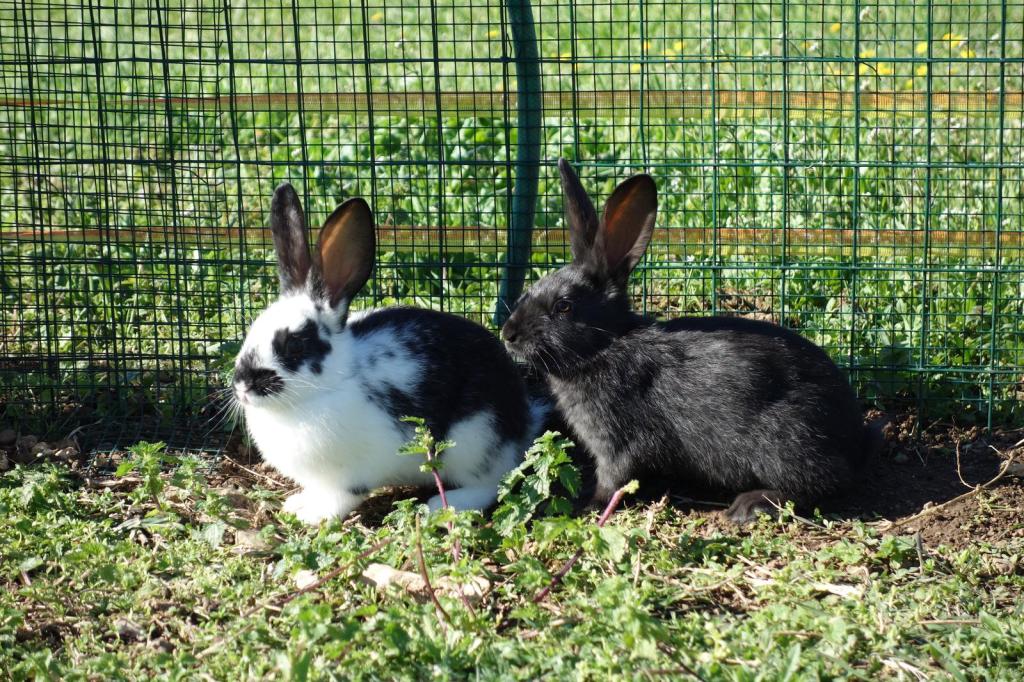
At the University of Perugia (UNIPG), the first year of the project will focus on evaluating the effects of different genotypes—comparing pure breeds with commercial strains—under cage-free conditions. The trials will adopt animal-friendly reproductive techniques, including artificial insemination after weaning and ovulation induced through the intravaginal route, to ensure welfare remains a central priority.
In parallel, two dietary strategies will be tested: a standard control diet and an alternative feed rich in forage (over 70%) with reduced levels of cereals and soybean meal. This comparison will help identify nutritional approaches that better support rabbit health, behaviour, and sustainability.
Building on the results of the first year, the second phase of the research will implement the most promising combination of genotype and diet. The focus will then shift to evaluating the impact of pen structure—specifically whether sub-pens should remain connected or not—and of slaughter age (11 versus 13 weeks). These aspects will be assessed in relation to animal welfare indicators, such as aggression levels and the occurrence of body injuries.
 Rabbinout: no cage system for rabbits indoor and outdoor scenarios